Launch offer — valid today only

Read the GD&T Prints on Your Bench, Frame by Frame, in the Same Order Every Time With Every Callout Drawn Step by Step!

Feature control frames, datums A-B-C, MMC and bonus tolerance, position, flatness, parallelism, profile, runout and CMM checks: in the standard it's a wall of text. Here each topic fits on one page, with the drawing and what you need to remember. 64 illustrated pages.

SHOW ME THE DRAWINGS

🔒 Secure checkout · PDF by email · 30-day guarantee

One topic per pagethe drawing shows you the callout and the text walks you through it
64 illustrated pages11 parts, from what GD&T adds to a drawing to reading a full print
Up-to-date sourcesASME Y14.5-2018 (R2024) and the ASME GDTP Applicant Handbook (2026)

This Is What the Pages You Will Study Look Like

One concept per page, the drawing that shows you how it works and the boxes with what you need to know:

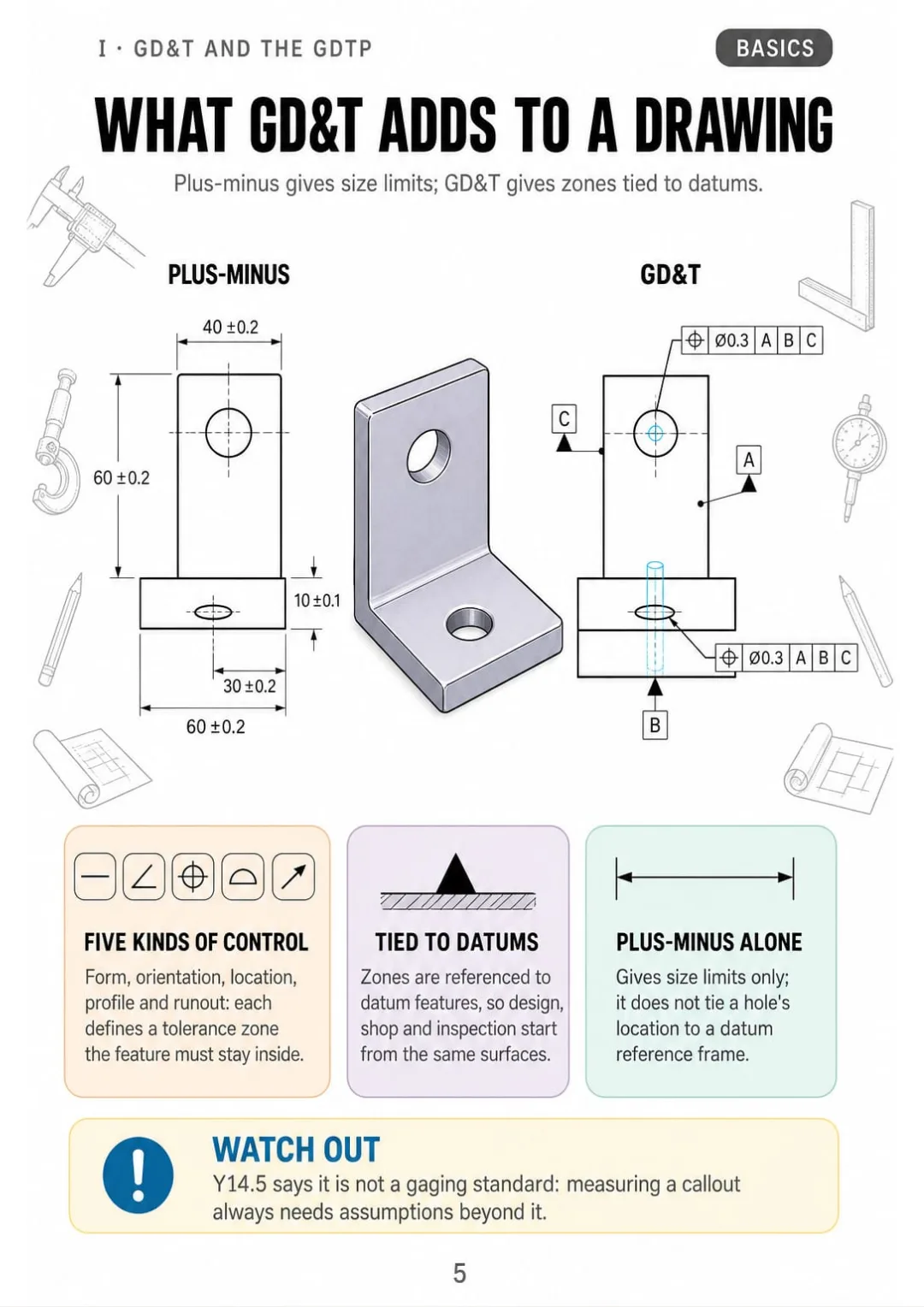
Same bracket, two drawings: plus-minus size limits vs GD&T zones tied to datums A, B, C.
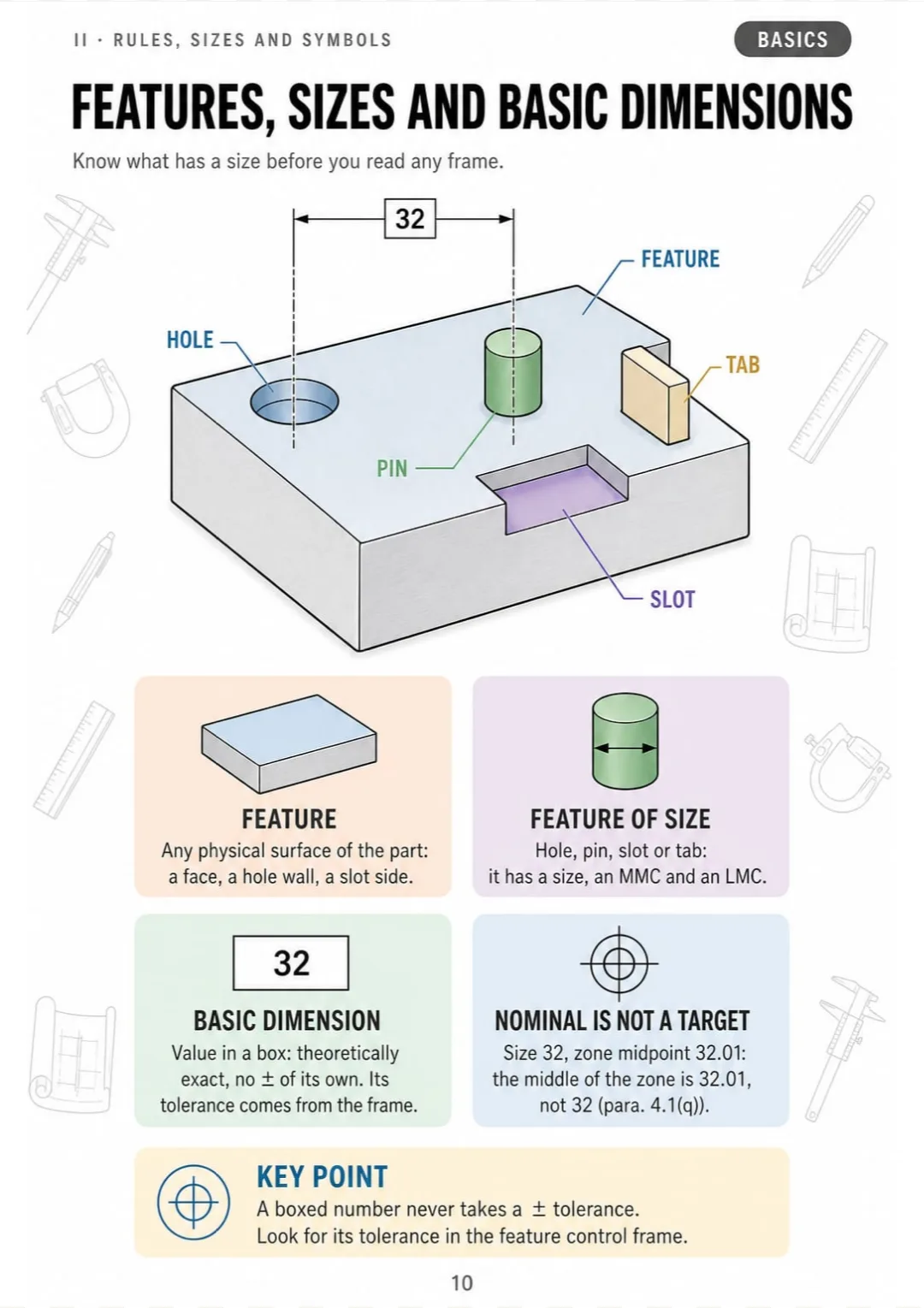
Feature vs feature of size, and why a boxed 32 has no ± of its own.
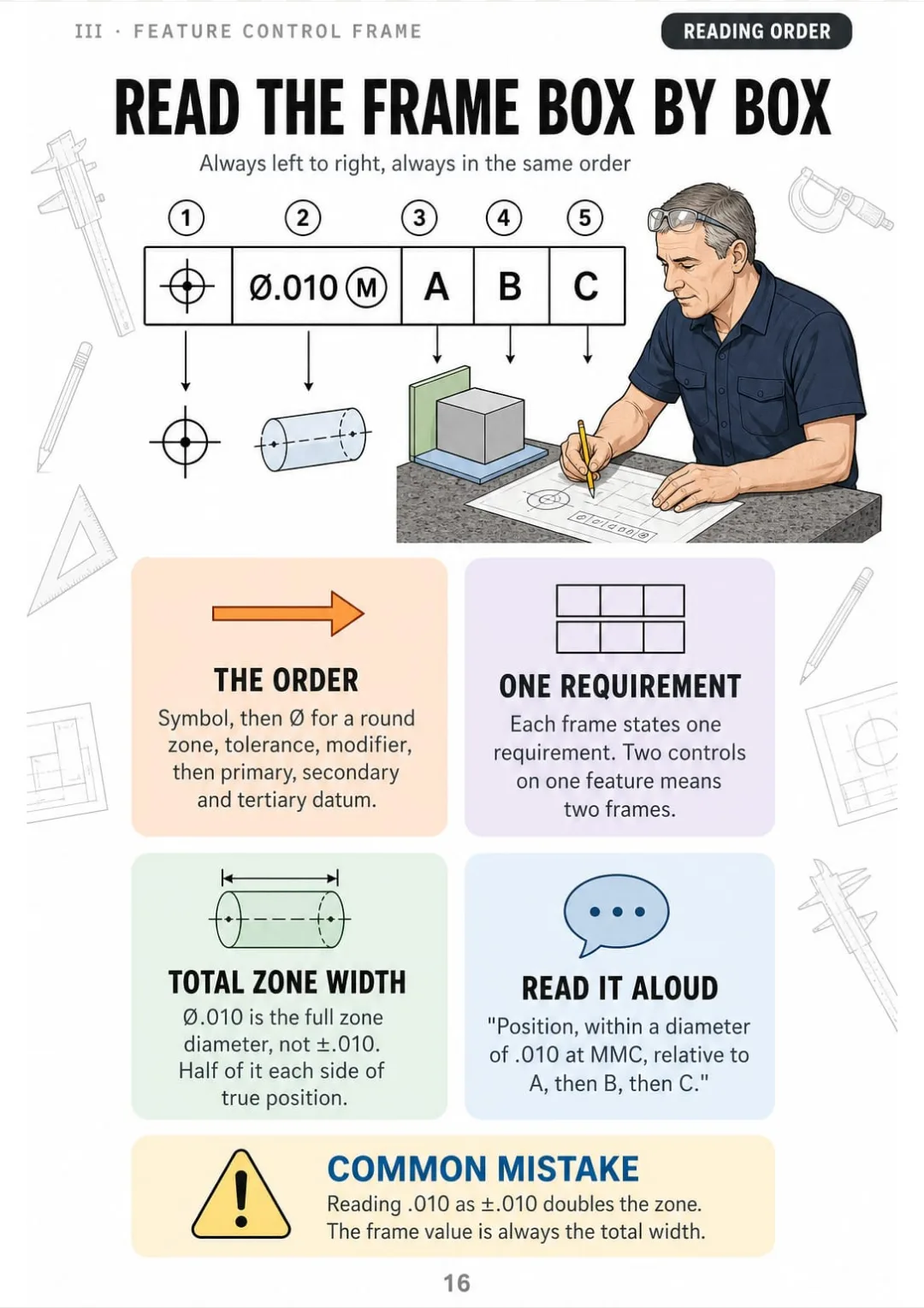
⌖ | Ø.010 Ⓜ | A | B | C, with each spoken phrase tied to its box
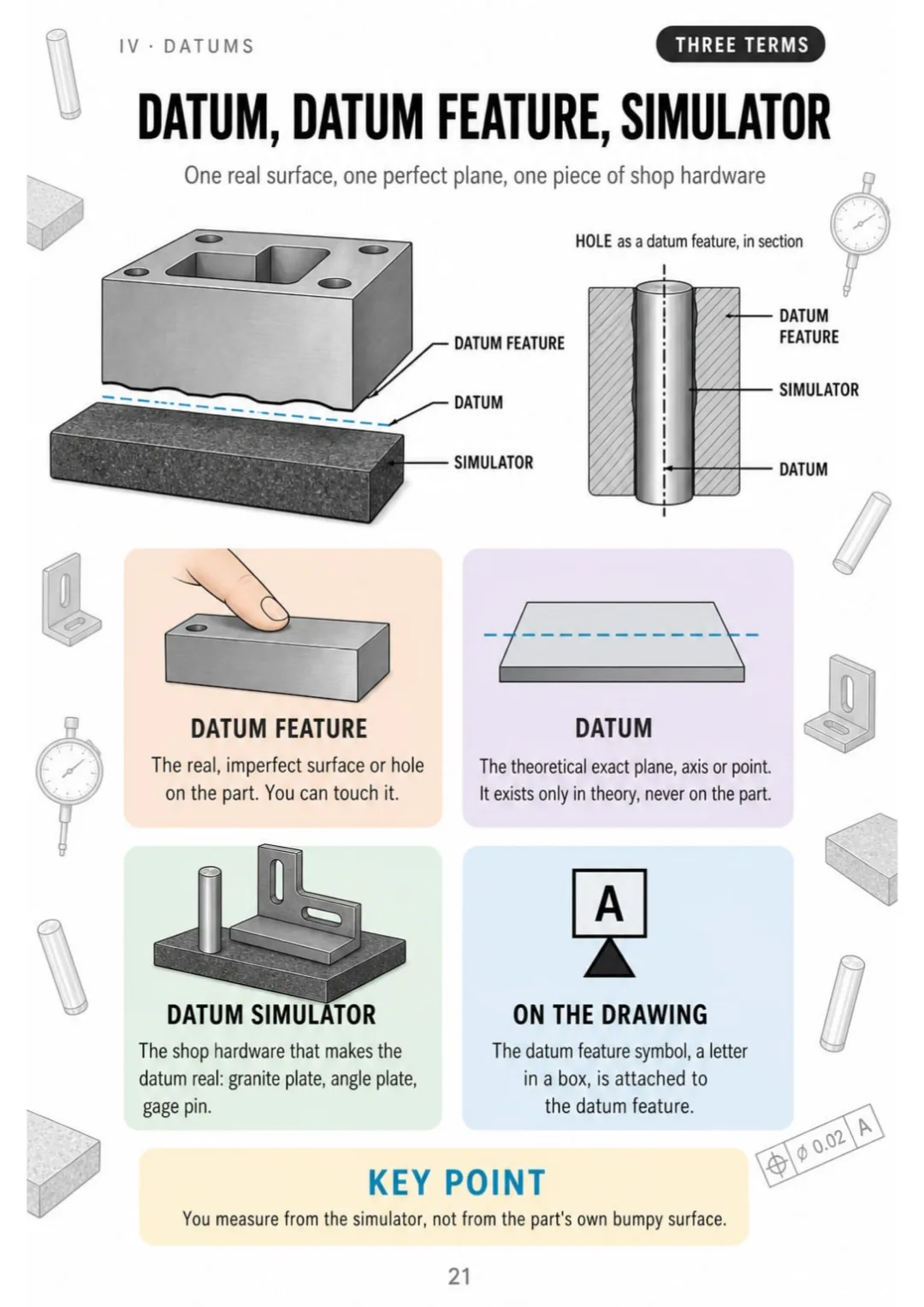
Datum feature = real surface · Datum = perfect plane · Simulator = granite plate or gage pin
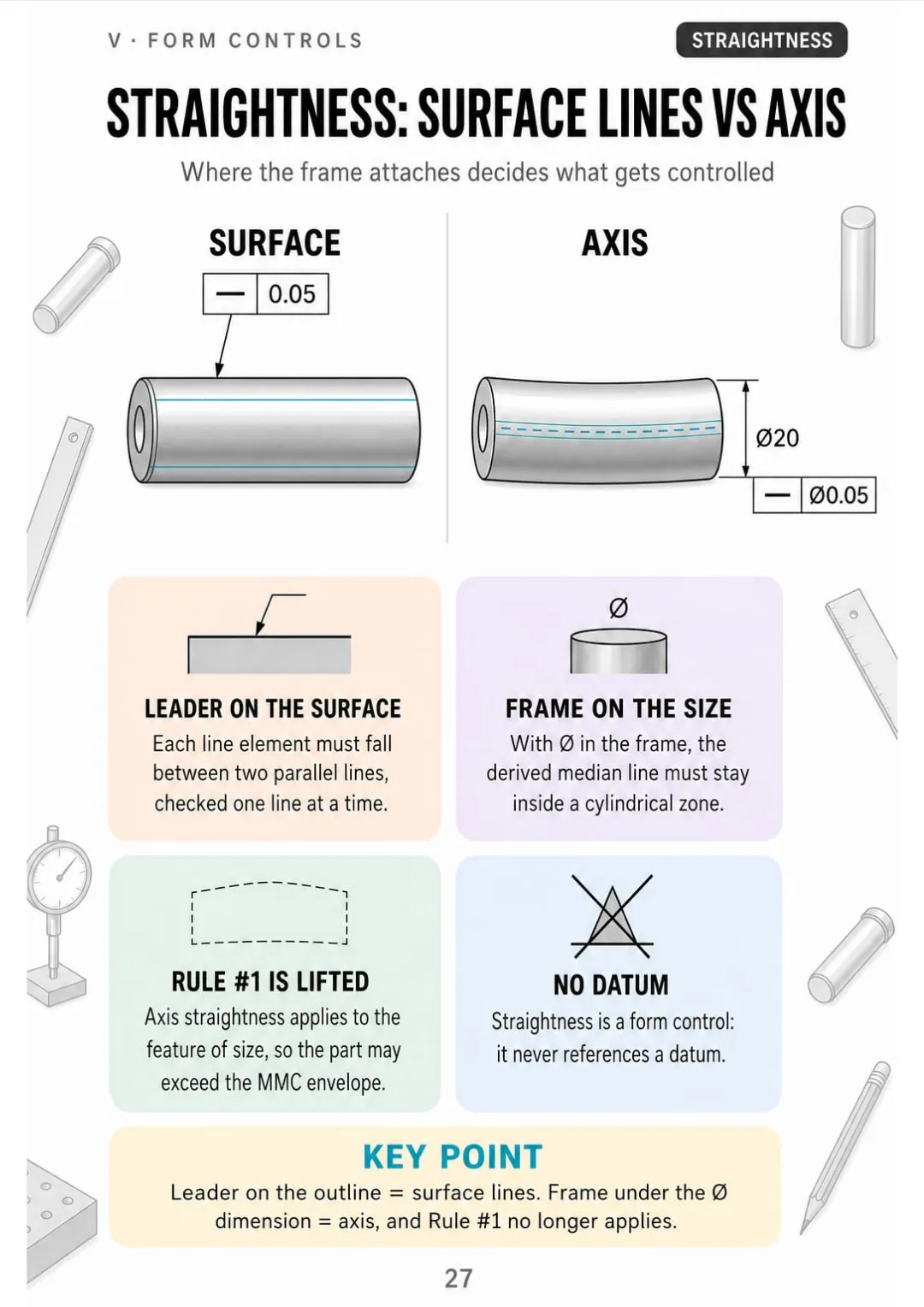
Surface straightness checks lines one by one; axis straightness uses a cylindrical zone and overrides Rule #1.
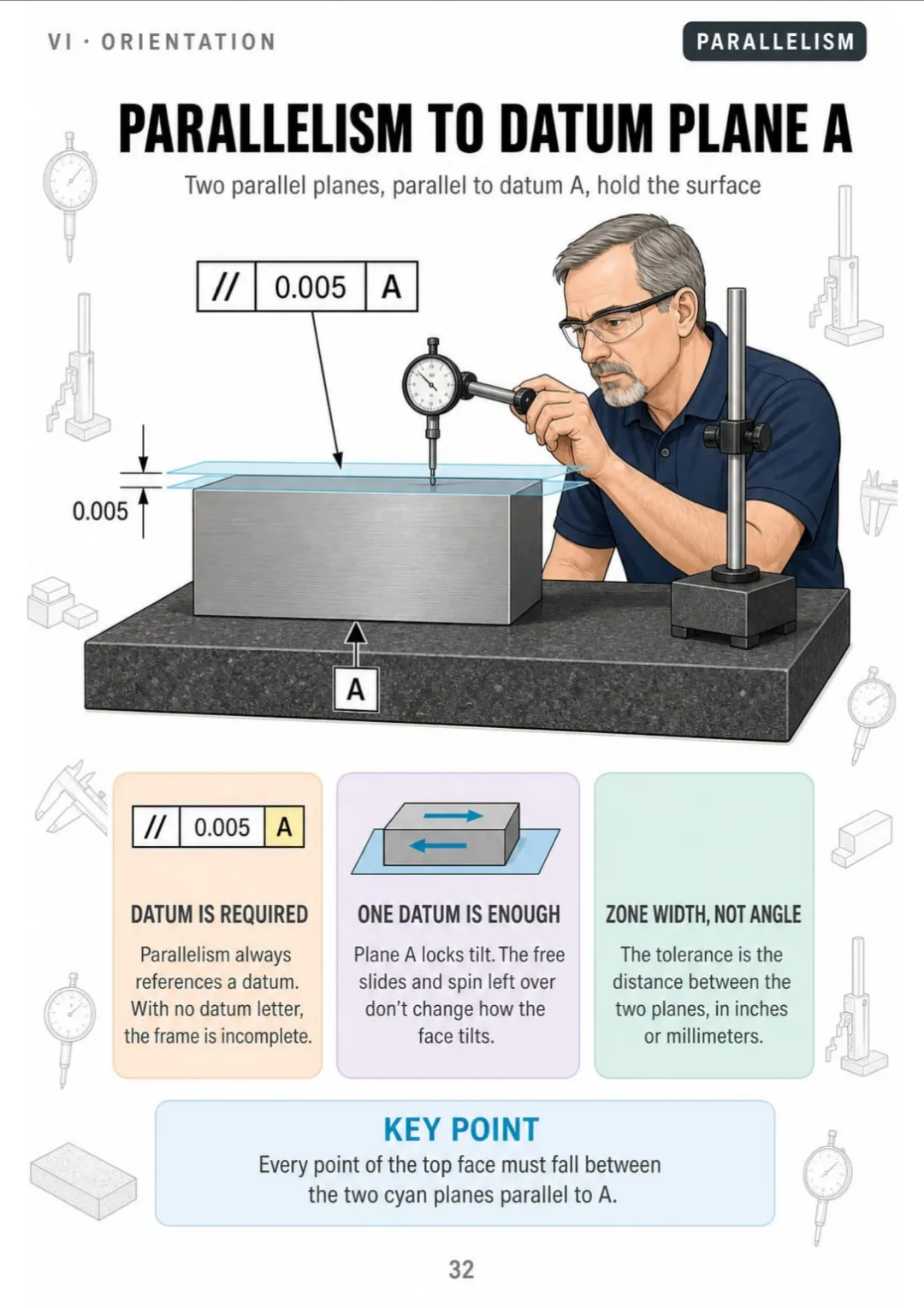
Parallelism = two parallel planes, parallel to datum A, one datum is enough
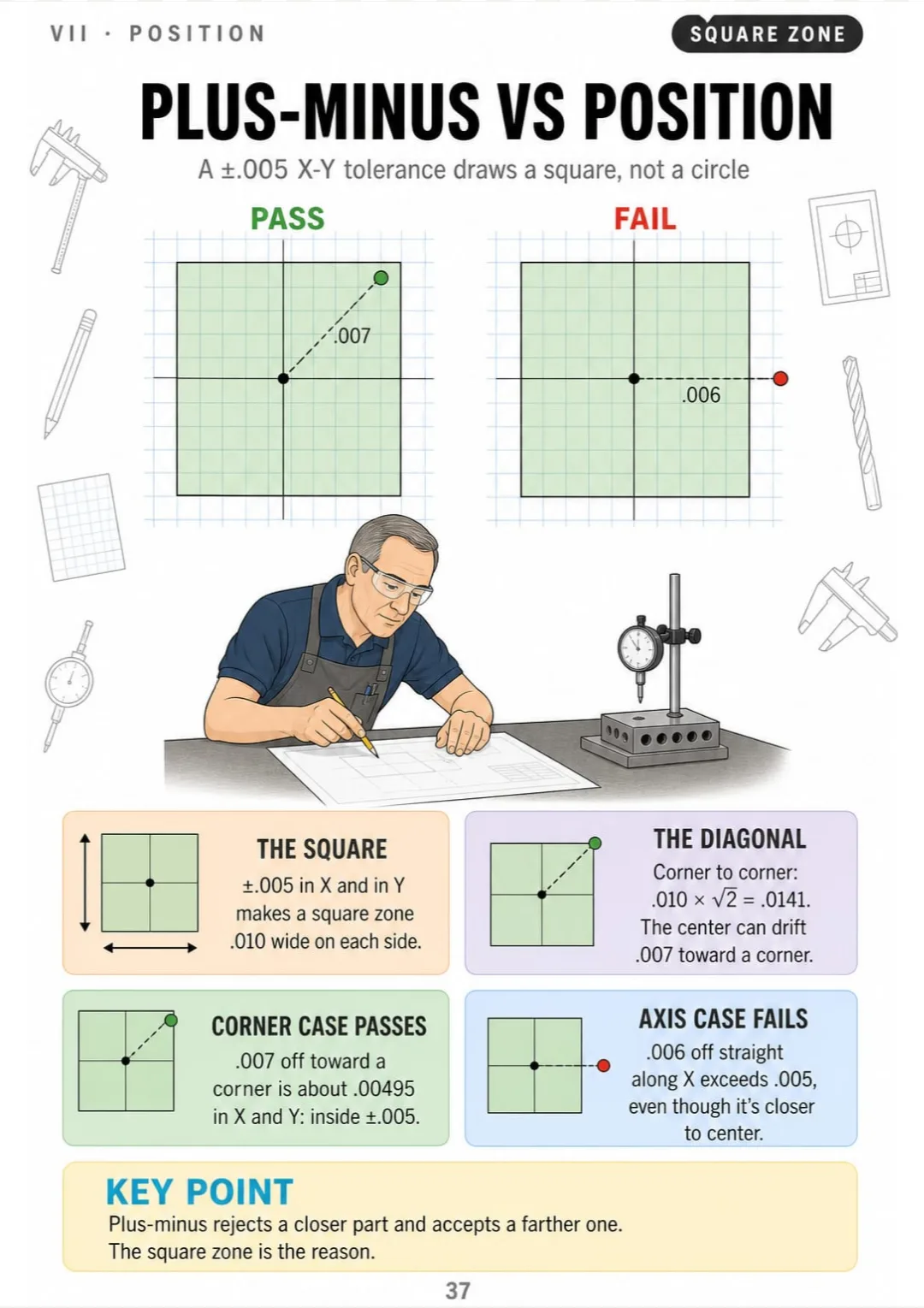
±.005 in X and Y = a .010 square: .007 toward a corner passes, .006 along an axis fails.
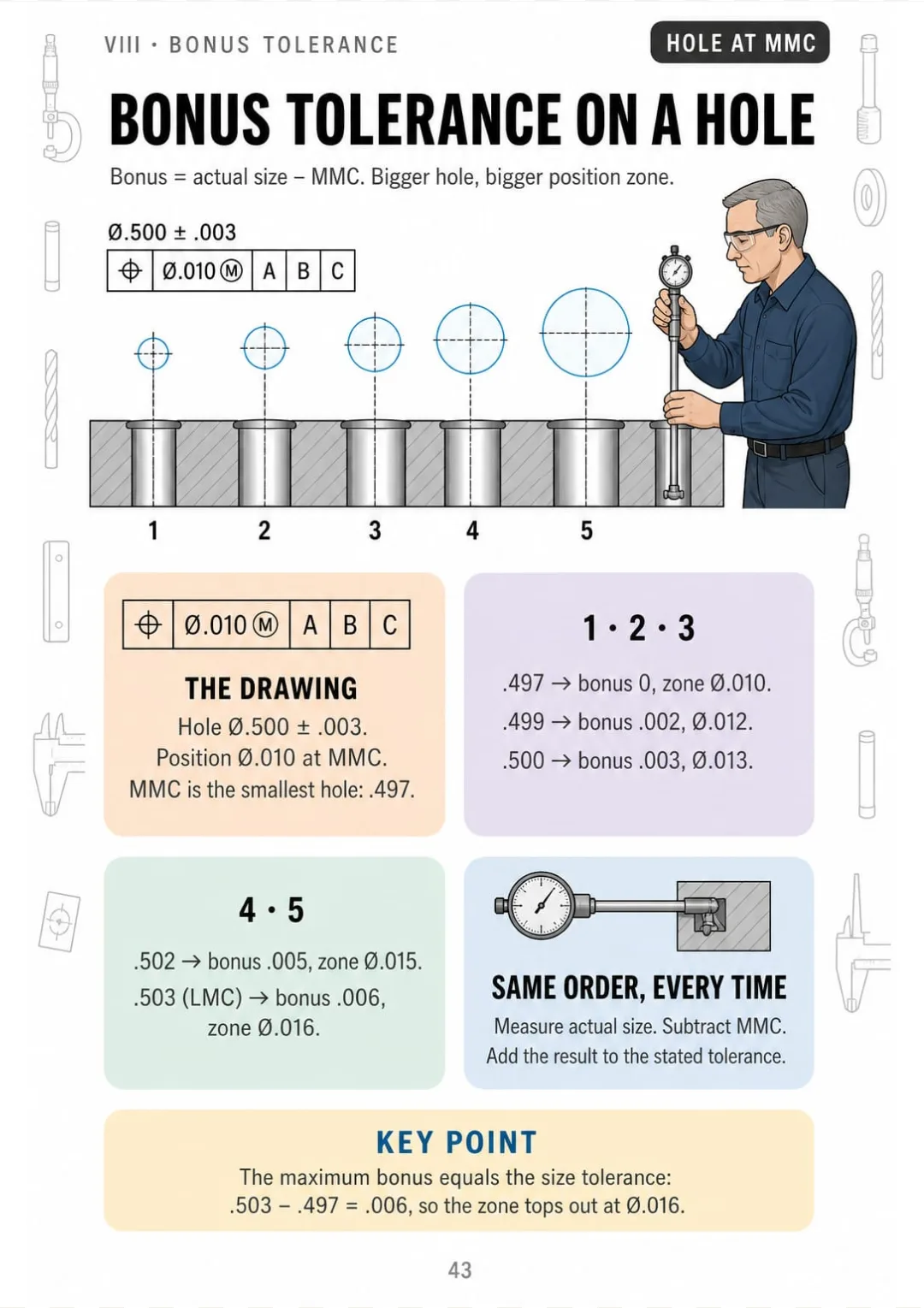
Hole Ø.500 ± .003, position Ø.010 at MMC: zone grows from Ø.010 to Ø.016.

Swipe to see more →

These are real pages from the book. The table of contents is the full one: 11 parts and 60 topics.

It's That Nobody Put It in Order for You.

You've read what ⌖ | Ø.010 Ⓜ | A | B | C means three times. You close the book...

...and you can't say what the Ⓜ applies to, or which datum the part sits on first. It was just lines of text.

⌖ | Ø.010 Ⓜ | A | B | C, with each spoken phrase tied to its box

Here the frame is one page, drawn large, box by box: symbol, Ø, tolerance, modifier, then datums A, B and C, each box with its phrase in plain words.

And on the pages next to it, each control gets its own: flatness, parallelism, position, profile and runout.

First you understand why it's read that way. Then the order sticks on its own.

SEE THE DIFFERENCE

Stop memorizing callouts you can't picture:

THIS
  • Page after page of dense text
  • Tolerances without a single drawing
  • With the print in front of you, you don't know where to start
A feature is understood as any physical portion of a part, including surfaces, pins, holes, tabs or slots. A feature of size is distinguished from a feature in that it consists of a single cylindrical or spherical surface, or of two opposed parallel elements, and is associated with a directly toleranced size dimension. A basic dimension, by contrast, is a theoretically exact value shown enclosed in a rectangle; it carries no tolerance of its own, its permissible variation being established exclusively by the tolerance stated in the related feature control frame or in general notes.
FOR THIS
  • Every callout drawn
  • One topic per page, with the rules in boxes
  • You remember it because you've seen it
Feature vs feature of size, and why a boxed 32 has no ± of its own.
CONTENTS

Take a Look at the 11 Parts and 60 Topics

GD&T and the standard, rules and symbols, the feature control frame, datums, form, orientation, position, bonus tolerance, profile and runout, measurement and reading full prints: 64 pages, all drawn

IGD&T, the Standard and the GDTP Exam · pp. 5-9
  1. What GD&T Is and Why Drawings Need It
  2. ASME Y14.5-2018 and Its Status in 2026
  3. The Optional ASME GDTP: Two Levels
  4. GDTP Exam Weights, Passing Score and Retakes
  5. How to Use This Sketchbook
IIRules, Sizes and Symbols · pp. 10-15
  1. Features, Features of Size and Basic Dimensions
  2. MMC and LMC on Holes and Pins
  3. Rule #1: The Envelope of Perfect Form
  4. Rule #2: RFS Is the Default
  5. The 12 Geometric Characteristic Symbols
  6. Where Concentricity and Symmetry Went
IIIThe Feature Control Frame · pp. 16-20
  1. Reading a Feature Control Frame Box by Box
  2. Diameter Symbol and Tolerance Zone Shape
  3. Material Condition Modifiers in the Frame
  4. Datum Feature Symbols and Datum Letters
  5. The Projected Tolerance Zone
IVDatums and the Datum Reference Frame · pp. 21-26
  1. Datum, Datum Feature and Datum Simulator
  2. Six Degrees of Freedom
  3. The 3-2-1 Rule on a Rectangular Block
  4. How A-B-C Precedence Changes the Setup
  5. Holes and Shafts as Datum Features
  6. Datum Targets on Rough Parts
VForm Controls · pp. 27-31
  1. Straightness of Surface Lines vs Axis
  2. Flatness Between Two Parallel Planes
  3. Circularity Between Two Concentric Circles
  4. Cylindricity Between Two Coaxial Cylinders
  5. When a Form Control Beats Rule #1
VIOrientation Controls · pp. 32-36
  1. Parallelism to a Datum Plane
  2. Perpendicularity of a Surface and of an Axis
  3. Angularity and the Basic Angle
  4. Orientation Also Limits Flatness
  5. The Hierarchy: Location, Orientation, Form
VIIPosition · pp. 37-42
  1. Plus-Minus Coordinates vs Position
  2. Cylindrical vs Square Zone: the 1.57 Factor
  3. Basic Dimensions Locate True Position
  4. Position of a Hole Pattern
  5. Floating and Fixed Fastener Cases
  6. Coaxial Features Located With Position
VIIIBonus Tolerance and Virtual Condition · pp. 43-47
  1. Bonus Tolerance Step by Step on a Hole
  2. Bonus Tolerance on a Pin
  3. LMC and Minimum Wall Thickness
  4. Virtual Condition Calculations
  5. Inner and Outer Boundaries
IXProfile and Runout · pp. 48-53
  1. Profile of a Line
  2. Profile of a Surface
  3. Bilateral, Unilateral and Unequal Zones
  4. Profile With and Without Datums
  5. Circular Runout
  6. Total Runout
XHow GD&T Is Measured · pp. 54-59
  1. Granite Surface Plate Grades
  2. Dial Indicator Setups for Flatness and Runout
  3. Go and No-Go Gauges for Rule #1
  4. Functional Gauges for Position at MMC
  5. CMM Points and Fitting Algorithms
  6. Measuring at 20 °C and Planning the Check
XIReading Drawings and Final Review · pp. 60-64
  1. Reading a Drawing From Title Block to Frame
  2. Walkthrough: A Fully Toleranced Bracket
  3. Which Y14.5 Edition Is on the Drawing
  4. Frequent Mix-Ups and Traps
  5. GDTP Exam Day Checklist

What If Every Topic Fit on a Single Page?

Picture this:

Instead of rereading half a page about bonus tolerance without being able to see it...

...you open the page and find the hole drawn at its smallest and at its largest size, with the position zone growing from Ø.010 to Ø.016 right beside it.

Surface straightness checks lines one by one; axis straightness uses a cylindrical zone and overrides Rule #1.

And datums, flatness, position, profile and runout turn into drawings and tables you can read at a glance.

You stop memorizing and start understanding.

That's exactly what The GD&T Sketchbook does. It's not “just another manual.” It's 11 parts and 60 drawn topics, and at the end a fully toleranced bracket walkthrough, the frequent mix-ups and an exam day checklist. Because what your brain sees in order, it remembers.

Because what your brain sees organized, it remembers.

Here Is What You Get with The GD&T Sketchbook:

Ipp. 5-9

GD&T, the Standard and the GDTP Exam

What GD&T adds to a drawing, Y14.5-2018 and its status in 2026, the two levels of the optional GDTP, its exam weights, passing score and retakes, and how to use the book.

IIpp. 10-15

Rules, Sizes and Symbols

Features and features of size, basic dimensions, MMC and LMC on holes and pins, Rule #1 and Rule #2, the 12 symbols and where concentricity and symmetry went.

IIIpp. 16-20

The Feature Control Frame

The frame read box by box, the Ø symbol and the shape of the zone, material condition modifiers, datum feature symbols and the projected tolerance zone.

IVpp. 21-26

Datums and the Datum Reference Frame

Datum, datum feature and simulator, six degrees of freedom, the 3-2-1 rule on a block, how A-B-C precedence changes the setup, holes and shafts as datums, and datum targets.

Vpp. 27-31

Form Controls

Straightness of surface lines and of an axis, flatness, circularity, cylindricity, and how a form control works with Rule #1.

VIpp. 32-36

Orientation Controls

Parallelism, perpendicularity of a surface and of an axis, angularity with its basic angle, how orientation also limits flatness, and the location-orientation-form hierarchy.

VIIpp. 37-42

Position

Plus-minus vs position, the square vs cylindrical zone and the 1.57 factor, true position from basic dimensions, hole patterns, floating and fixed fasteners, and coaxial features.

VIIIpp. 43-47

Bonus Tolerance and Virtual Condition

Bonus tolerance worked step by step on a hole and on a pin, LMC and minimum wall, virtual condition, and inner and outer boundaries.

IXpp. 48-53

Profile and Runout

Profile of a line and of a surface, bilateral, unilateral and unequal zones, profile with and without datums, and circular and total runout.

Xpp. 54-59

How GD&T Is Measured

Surface plate grades, dial indicator setups, go/no-go gages, functional gages for position at MMC, CMM points and fitting, and checking at 20 °C (68 °F).

XIpp. 60-64

Reading Drawings and Final Review

Reading a print from title block to frame, a fully toleranced bracket, which Y14.5 edition is on the drawing, frequent mix-ups and a GDTP exam day checklist.

At the end of the book: A fully toleranced bracket walkthrough, the frequent mix-ups and a GDTP exam day checklist.


And That Is Not All: 2 More Books, Free

The 12 Symbols Card

BONUS 1: «The 12 Symbols Card»

Value on its own: US$ 17.90

All 12 Y14.5-2018 geometric characteristic symbols on one printable page, each with its tolerance zone sketched beside it, to pin up next to your bench.

250 GD&T Terms on Cards

BONUS 2: «250 GD&T Terms on Cards»

Value on its own: US$ 14.90

Review the vocabulary in short sessions: the term on the front, a one-line definition and a tiny sketch on the back, so MMC, virtual condition and datum feature simulator stop blurring together.

The GD&T Sketchbook + 2 Free Books

  • The GD&T Sketchbook: 64 illustrated pagesUS$ 87
  • BONUS 1: The 12 Symbols CardUS$ 17.90
  • BONUS 2: 250 GD&T Terms on CardsUS$ 14.90
  • High-resolution PDF to printIncluded
Total value US$ 119.80
YOUR PRICE:
US$ 37
You save US$ 82.80
YES, I WANT THE GD&T SKETCHBOOK FOR US$ 37

📄 This is a digital PDF book sent to your email: nothing is printed or shipped.

Secure purchaseEncrypted payment30-day guarantee

PDF by email: The GD&T Sketchbook reaches your inbox as a PDF, and the two free books come by email too. One-time payment, no installments or hidden costs.

Is This Book for You?

You're learning GD&T on the job

You're learning GD&T on the job

One concept per page, from features of size to datums and position, to study on your breaks and keep next to the print.

You're preparing for the optional GDTP

You're preparing for the optional GDTP

The Y14.5-2018 concepts in a set order, the two exam levels laid out, and an exam day checklist at the end.

You already inspect or machine to GD&T prints

You already inspect or machine to GD&T prints

A quick reference for daily calls: bonus tolerance with numbers, the A-B-C setup on the surface plate and how each callout is checked on a gage or a CMM.

To Sum Up: Here Is What You Get

US$ 119.80US$ 37
YES, I WANT THE GD&T SKETCHBOOK FOR US$ 37

📄 This is a digital PDF book sent to your email: nothing is printed or shipped.

30DAYS
GUARANTEE

30-Day Guarantee

30-day guarantee: tell us what didn't work and we'll refund 100%.

You have 30 days to try The GD&T Sketchbook and the two bonus books. If it doesn't work for you, write to us, tell us what didn't work and we'll refund 100% of what you paid. One-time payment, no subscriptions, no surprises.

Frequently Asked Questions

How do I get it?

After you buy, you get an email with The GD&T Sketchbook as a high-resolution PDF, to read on your phone or print. The two bonus books, The 12 Symbols Card and 250 GD&T Terms on Cards, also come by email.

Is it a monthly payment or one-time?

One-time payment of US$ 37. No installments, no subscription.

Who is it for?

For quality inspectors, machinists, CNC programmers, drafters and design engineers who work with GD&T prints, and for anyone preparing for the optional ASME GDTP. It builds up from features of size, so it works whether GD&T is new to you or you have years of ± prints behind you. Check the table of contents above to see the topics.

My plant still has Y14.5-2009 prints. Does it work for me?

Yes. It's based on ASME Y14.5-2018 (reaffirmed 2024), explained in our own words and drawings, and on the ASME GDTP Applicant Information Handbook for the exam pages. The frame, datums, position and bonus tolerance read the same way on 2009 prints. One page shows how to tell which edition is on the drawing and what changed, such as concentricity and symmetry, which the 2018 edition removed.

Is this official ASME material?

No. It's an independent study book, not affiliated with or endorsed by ASME, and it doesn't come with a certificate or a GDTP credential. It doesn't reproduce the text or the figures of the standard, and every drawing is our own. If you need the official wording, you'll need to buy Y14.5 from ASME.

Does it replace the standard or a GD&T course?

No. It's a visual reference to study and review. It doesn't replace the standard, a GD&T course, your company's quality procedures or what your customer's drawing requires.

Are the practice questions the real GDTP questions?

No. The book itself doesn't include test questions. The practice questions in the optional add-ons are original, exam-style questions written for this material, not official ASME GDTP questions.

Can I print it?

Yes. It's a high-resolution PDF you can print at home or at work and keep next to the bench. The 12 Symbols Card is made to pin up.

What if I don't like it?

You have 30 days. Write to us, tell us what didn't work and we'll refund 100% of what you paid.

One Last Thing Before You Decide...

You don't have to reread the same page hoping it sticks this time.

You don't have to memorize callouts you can't picture.

And you certainly don't have to face the next print without knowing where to start.

There's an easier way. And it's one click away. Now it's your turn.

One-time payment: US$ 37 · Guarantee: 30 days · PDF by email

YES, I WANT THE GD&T SKETCHBOOK FOR US$ 37

📄 This is a digital PDF book sent to your email: nothing is printed or shipped.